
Modular monolith vs. microservices: which architecture fits your project?
Microservices sound modern — but they're not the right call for every project. A sober comparison of both architectures, with clear recommendations for when to use which.
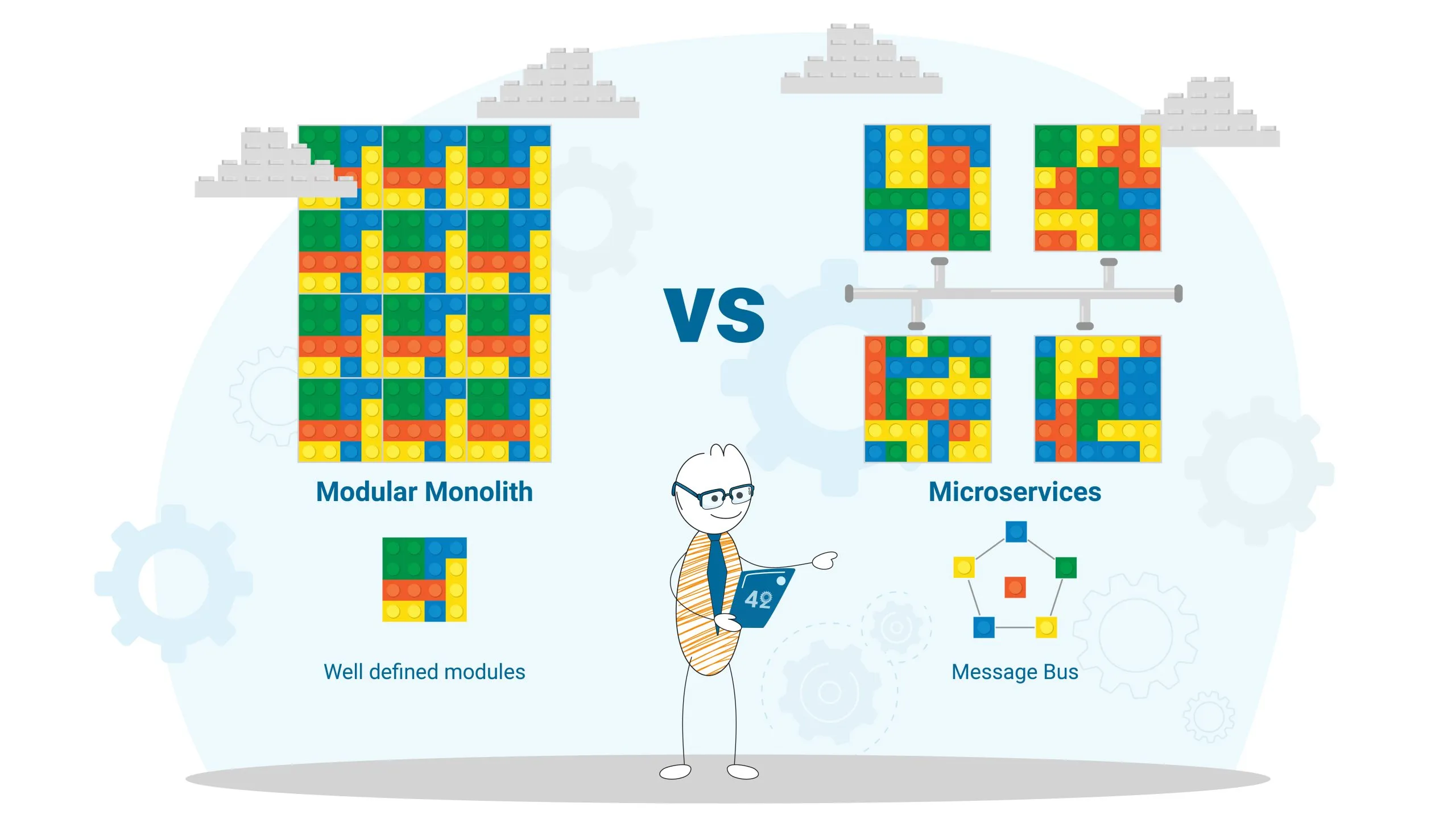
Microservices are one of the most hyped architecture patterns of the last decade. They promise scalability, technology freedom, isolated failures — and they deliver on that. But at what price? In many projects we’ve reviewed, a well-structured modular monolith would have been the better choice.
This article compares both architectures plainly — and shows when each is the right form.
What is a modular monolith?
A modular monolith is a software architecture where the application consists of clearly structured, separate modules — but is deployed and executed as a single unit. The modules communicate directly within one process, without network protocols.
Advantages
- Lower complexity through a single deployment
- Efficient communication via direct function calls
- Simpler data consistency with centralised databases
- Easier testing without distributed integration
Disadvantages
- Limited scalability (the whole app scales, not individual modules)
- Risk of growing coupling between modules over time
- Full redeploy required even for small changes
What are microservices?
Microservices split an application into multiple small, independent services that communicate over the network. Each service is specialised in specific functions and can be developed, deployed, and scaled separately.
Advantages
- Independent scaling per service
- Technology freedom per service
- Limited blast radius for single-service failures
- Independent deployment cycles
Disadvantages
- Complex infrastructure management
- Data consistency across service boundaries is demanding
- Higher latency from network communication
- Expensive end-to-end testing
Side-by-side
| Criterion | Modular monolith | Microservices |
|---|---|---|
| Development complexity | Lower (shared codebase) | Higher (multiple independent services) |
| Deployment | Whole application | Per service |
| Scaling | Whole app | Per service |
| Communication | In-process | Network-based |
| Infrastructure cost | Lower | Higher |
| Fault tolerance | Module failure hits the whole app | Service-level isolation |
| Technology diversity | Single stack | Per-service choice |
| Testability | Simple integration tests | Complex distributed testing |
Architecture aspects in detail
Databases and data management
Modular monolith. All modules typically share a central database. This simplifies consistency and transaction management across module boundaries.
- Advantages: Simpler consistency, centralised maintenance.
- Disadvantages: The database becomes the bottleneck under scale; schema changes affect every module.
Microservices. Each service typically has its own database. This enables per-service technology choice but complicates data consistency. Eventual consistency and distributed transactions become the central challenge.
- Advantages: Technology freedom, independent scalability.
- Disadvantages: Consistency is hard; coordination overhead is real.
Service bus and asynchronous communication
In a monolith a service bus is usually unnecessary — modules call each other synchronously and directly.
In microservices the service bus becomes middleware: it decouples services, enables asynchronous processing, and makes adding new services easier. The trade-off: additional infrastructure complexity and potential latency.
Scalability and load distribution
Monolith. Primarily vertical scaling (more resources on one server). The entire application scales even if only one module generates load.
Microservices. Horizontal scaling per service. Granular, but with substantially more complex infrastructure management.
Testing and debugging
Monolith. Tests run within one process — integration is simpler, debugging is local.
Microservices. Each service needs its own tests plus end-to-end validation. Distributed debugging requires specialised tooling (distributed traces, central logging).
Security
Monolith. Centralised security strategy. Smaller attack surface — no network communication between modules.
Microservices. Each service must be hardened separately. Internal communication needs its own authentication mechanisms (e.g. OAuth-based token flows).
Technology diversity and innovation
Monolith. Unified tech stack — easier ramp-up, less flexibility.
Microservices. The best technology per service can be chosen — at the cost of steeper learning curves and more complex maintenance.
Clear recommendations
When a modular monolith is the right call
- Small to mid-sized projects without extreme scaling demands
- Teams of limited size — lower development and infrastructure complexity
- Early project phases with fluid requirements where fast implementation matters
When microservices are the right path
- Large, complex projects with independent component development and scaling
- Specialised teams with distributed organisational structures
- Projects with high requirements on scalability and fault tolerance
Conclusion
Both architectures have their place — they aren’t competitors, they’re complements. A modular monolith offers an efficient, maintainable structure for small and mid-sized projects. Microservices deliver maximum flexibility, at the cost of higher development and operational overhead.
Our recommendation: pick the architecture that fits today’s and the foreseeable requirements. A well-structured modular monolith can be a solid foundation from which individual services are gradually extracted as needs grow. In practice, “start as a monolith, extract deliberately” almost always beats the big-bang “microservices from day one” approach.
Wondering which architecture fits your project? We’re happy to advise — get in touch for an architecture consultation.
Keep reading
Related articles
-
March 23, 2024
Software Erosion: A Silent Threat to Long-Term Software Quality
Software erosion costs more long-term than any single bug. How to spot it early, what the silent decay really costs, and how to stop it.
Read article -
August 30, 2024
Storing secrets and keys securely with Azure Key Vault
API keys, passwords, and certificates don't belong in config files or source code. How Azure Key Vault centralises sensitive data securely — and how we wire it cleanly into .NET applications.
Read article -
July 31, 2024
Requirements vs. user stories: where the real difference lies
Requirements and user stories are often used interchangeably in projects — and that costs clarity. What each actually delivers, where they complement each other, and when which form gets you to the goal.
Read article
